
Causes, Symptoms, and Emerging Regenerative Treatment Approaches
Understanding Degenerative Disc Disease and Disc Herniation
Degenerative Disc Disease (DDD) and herniated discs are common spinal conditions that can cause chronic back pain, nerve irritation, and reduced mobility. These conditions occur when the spinal discs that cushion the vertebrae begin to deteriorate or become damaged.
Spinal discs serve as shock absorbers between the vertebrae, allowing the spine to remain flexible while supporting the weight and movement of the body. Each disc consists of two primary structures:
- Nucleus Pulposus – a soft, gel-like center that absorbs pressure and distributes load across the spine
- Annulus Fibrosus – a tough outer ring made of collagen fibers that protects the nucleus and maintains structural integrity
When discs begin to degenerate or rupture, they may cause inflammation, structural instability, or compression of nearby nerves, leading to significant pain and neurological symptoms.
Although the term “degenerative disc disease” sounds severe, it is not technically a disease but rather an age-related or injury-related degenerative process that affects the intervertebral discs.
The Biology of Disc Degeneration
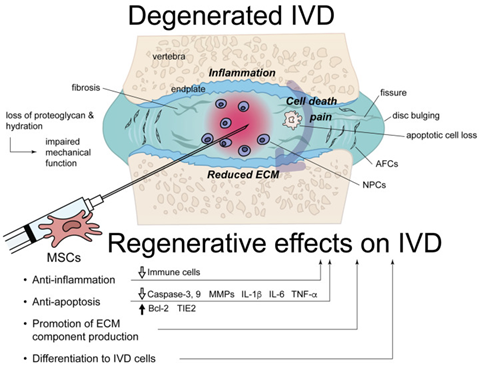
Intervertebral discs have limited blood supply, meaning they rely largely on nutrient diffusion from surrounding tissues. Because of this limited circulation, discs have a reduced ability to repair themselves once damaged.
Several biological changes occur as discs degenerate:
Loss of Hydration
Healthy discs contain a high percentage of water, which allows them to remain flexible and absorb mechanical forces.
With aging or injury:
- Water content decreases
- Discs lose height
- Shock absorption declines
This process increases stress on the surrounding vertebrae and joints.
Collagen Breakdown
The annulus fibrosus is composed primarily of collagen fibers that maintain disc stability. Over time, these fibers may weaken or develop small tears.
These structural defects can allow the inner disc material to bulge or protrude outward.
Inflammation
Degenerating discs often release inflammatory molecules that can irritate nearby nerves and surrounding tissues.
Inflammation may contribute to:
- Chronic back pain
- Nerve irritation
- Muscle spasms
- Reduced spinal mobility
What Is a Herniated Disc?
A herniated disc occurs when the inner nucleus pulposus pushes through a weakened or torn area of the annulus fibrosus.
Depending on the severity, disc herniations may be described as:
Disc Bulge
The disc extends beyond its normal boundaries but the outer ring remains largely intact.
Disc Protrusion
A more pronounced bulging occurs where the nucleus begins pushing against the outer ring.
Disc Extrusion
The inner material breaks through the outer ring and extends outward.
Disc Sequestration
A fragment of disc material separates and may migrate into the spinal canal.
When herniated disc material presses on nearby nerves, it can cause significant pain and neurological symptoms.
Common Locations for Disc Herniation
Disc degeneration and herniation most commonly occur in areas of the spine that experience the greatest mechanical stress.
Lumbar Spine (Lower Back)
The lumbar spine bears most of the body’s weight and is the most common site of disc herniation.
Symptoms may include:
- Lower back pain
- Sciatica (radiating leg pain)
- Numbness or tingling in the leg or foot
- Muscle weakness
Cervical Spine (Neck)
Herniated discs in the neck may affect nerves that travel into the arms.
Symptoms may include:
- Neck pain
- Shoulder pain
- Arm pain or numbness
- Weakness in the hands or arms
Symptoms of Degenerative Disc Disease and Herniated Discs
Symptoms vary depending on the severity and location of the disc damage.
Common symptoms include:
Chronic Back or Neck Pain
Pain may be localized to the affected area and may worsen with movement, lifting, or prolonged sitting.
Radiating Nerve Pain
Compression of spinal nerves can cause pain that travels along the path of the nerve.
Examples include:
- Sciatica in the legs
- Radiculopathy in the arms
Numbness and Tingling
Nerve irritation may lead to abnormal sensations in the extremities.
Muscle Weakness
If motor nerves are affected, individuals may experience weakness in the arms or legs.
Reduced Mobility
Pain and muscle guarding can limit spinal movement and daily activity.
Risk Factors
Several factors increase the likelihood of disc degeneration and herniation.
Aging
Disc degeneration naturally occurs as part of the aging process.
Repetitive Mechanical Stress
Occupations or activities involving heavy lifting, twisting, or repetitive bending can increase disc strain.
Sedentary Lifestyle
Weak core muscles may place additional stress on spinal discs.
Poor Posture
Chronic poor posture can increase pressure on certain spinal segments.
Trauma or Injury
Accidents, falls, or sports injuries can damage disc structures.
Genetic Factors
Some individuals are genetically predisposed to earlier disc degeneration.
Conventional Treatment Approaches
Most cases of disc-related pain are initially treated with conservative therapies.
Physical Therapy
Therapeutic exercises may help strengthen spinal support muscles and improve posture.
Anti-Inflammatory Medications
Medications may help reduce inflammation and relieve pain.
Epidural Steroid Injections
Corticosteroid injections may temporarily reduce inflammation around affected nerves.
Surgical Treatment
In severe cases involving persistent nerve compression or neurological deficits, surgery may be considered.
Procedures may include:
- Discectomy (removal of herniated disc material)
- Laminectomy (removal of bone to relieve pressure)
- Spinal fusion (stabilizing affected vertebrae)
Individuals seeking further information may contact us to discuss whether a consultation with a physician would be appropriate
Contact Us
Regenerative Medicine and Spinal Disc Health
Regenerative medicine focuses on supporting the body’s natural healing mechanisms, particularly in tissues with limited regenerative capacity such as spinal discs.
These therapies aim to improve the biological environment surrounding damaged discs and irritated nerves.
Platelet-Rich Plasma (PRP)
PRP is created from a patient’s own blood and contains concentrated platelets that release growth factors involved in tissue repair.
In spinal conditions, PRP may support:
- Reduction of inflammation
- Healing of ligaments and connective tissue
- Improved blood supply to surrounding structures
- Support for disc repair signaling
PRP has been studied in orthopedic and spine medicine as a potential adjunctive treatment for chronic spinal pain.
Platelet-Rich Fibrin (PRF)
PRF is an advanced platelet therapy that forms a fibrin matrix capable of gradually releasing growth factors over time.
Potential benefits include:
- Sustained biological signaling
- Improved connective tissue healing
- Support for spinal ligament repair
- Reduction of local inflammation
PRF may help support the healing environment around injured spinal tissues.
Stem Cell Therapy
Stem cells are specialized cells capable of influencing tissue repair through regenerative signaling.
In spinal medicine, stem cells are being studied for their potential role in:
- Supporting disc tissue regeneration
- Modulating inflammation
- Promoting cellular repair pathways
- Supporting nerve healing
Stem cells primarily work through paracrine signaling, releasing molecules that regulate healing and tissue maintenance.
Exosome Therapy
Exosomes are microscopic extracellular vesicles released by cells that contain biological signaling molecules.
These vesicles help regulate communication between cells and play an important role in tissue repair.
Potential roles in spinal health include:
- Supporting cellular communication during healing
- Reducing inflammatory signaling
- Enhancing tissue repair pathways
- Supporting nerve health
Exosome-based therapies are an emerging area of regenerative medicine research.
Potential Benefits of Regenerative Therapies
While research is ongoing, regenerative medicine therapies may support:
- Reduced inflammation in spinal tissues
- Improved healing of ligaments and connective tissues
- Support for disc repair signaling
- Improved nerve health
- Enhanced tissue regeneration pathways
These therapies aim to optimize the biological environment surrounding injured spinal structures.
Frequently Asked Questions
Can a herniated disc heal on its own?
In some cases, the body can gradually reabsorb herniated disc material and symptoms may improve over time.
Is degenerative disc disease reversible?
Disc degeneration is typically a gradual process, but treatments may help manage symptoms and support spinal health.
When is surgery necessary?
Surgery may be considered when severe nerve compression causes persistent pain, weakness, or loss of function that does not respond to conservative treatments.
Can regenerative therapies help disc conditions?
Regenerative therapies are being studied for their potential to support tissue repair and reduce inflammation in spinal conditions.
Who may be a candidate for regenerative treatments?
Individuals experiencing chronic spinal pain related to:
- Disc degeneration
- Herniated discs
- Ligament injuries
- Nerve irritation
Below is a condensed but detailed educational page for Osteoarthritis of the Knees, Hips, and Ankles, written in the same structure and tone as the other condition pages you’ve been creating for your website.